What to Automate in Paid User Acquisition: 25 Mobile UA Checks, Ranked by Spend at Risk
What to automate in paid user acquisition: 25 checks UA teams should stop running by hand, each with its formula, why humans skip it, and what's at risk.
If you're deciding what to automate in paid user acquisition, start with the checks that put the most spend at risk when they're missed and that humans skip most often. Those are rarely the ones on your dashboard. Account-level CPI gets looked at every morning anyway. The money leaks through ad set failures hidden inside healthy campaigns, small markets nobody looks at, measurement breaks that look like performance changes, and winners held back by a budget cap. Below are 25 checks, ranked by our judgment of spend at risk when skipped. Each comes with the one-line formula and the reason people stop running it by hand.
Before any of them: the validity gate. Automating a check without a volume and materiality floor gives you an alert stream you'll learn to ignore within a week. Every check below assumes slices with too little data are suppressed or pooled first. See minimum sample size for UA decisions.
Tier 1: automate these first (1–8)
- 1. Measurement break — the same step change in installs, ROAS or retention across every campaign and network on one date, with delivery unchanged. Why humans skip it: a break looks exactly like a performance drop, and people react to it by moving budget. Catching it first saves you from reallocating on bad data. Guide: ROAS dropping?
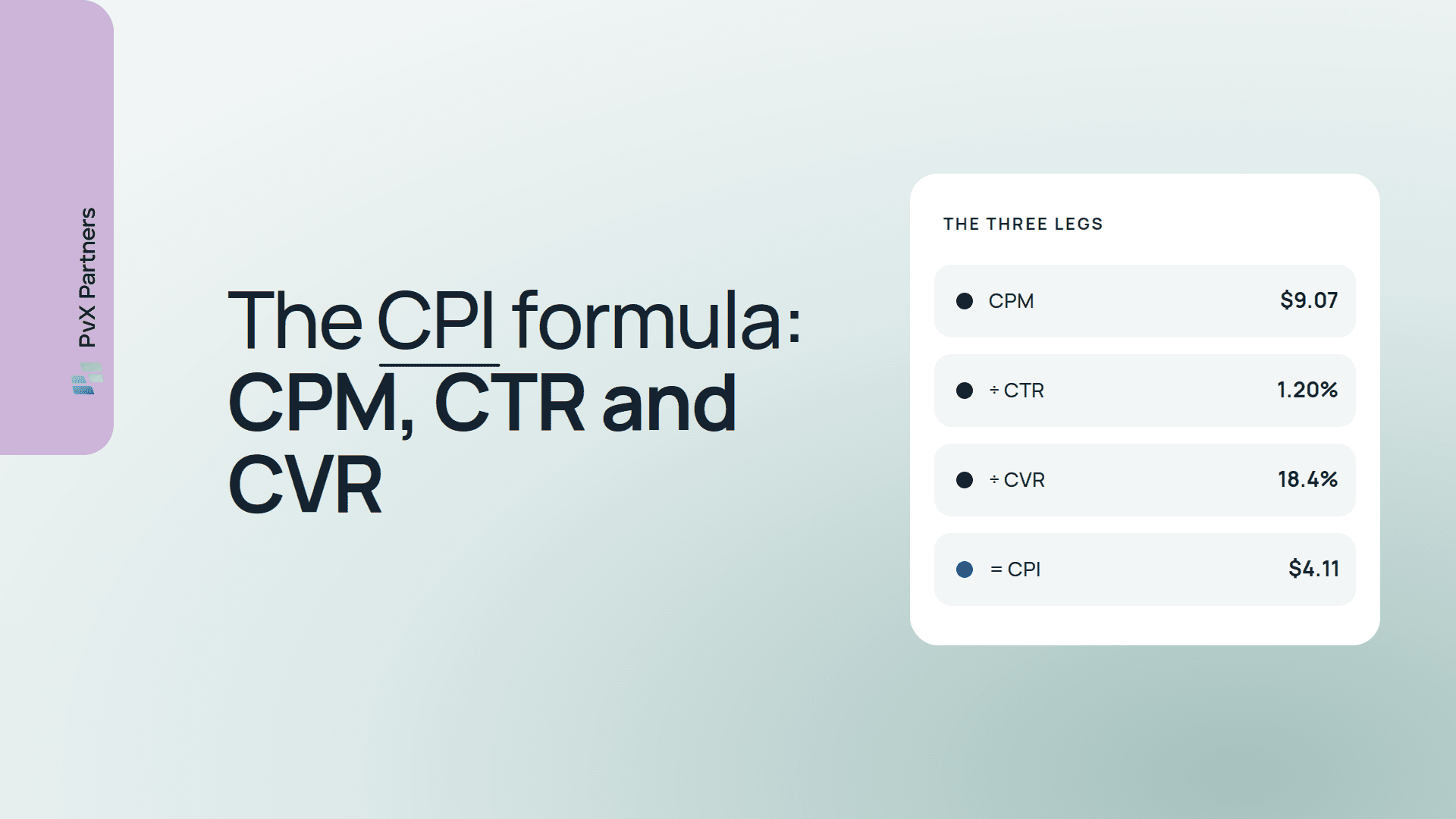
- 2. CPI trend by network, decomposed — spend ÷ installs against its own 28-day baseline, split into CPM, CTR and CVR legs. Why humans skip it: people check CPI but not the legs, so they fix the wrong thing. Guide: why is my CPI increasing?
- 3. Dx ROAS trend by campaign, on matured cohorts — cohort revenue through day X ÷ cohort spend, compared at equal cohort age. Why humans skip it: the calendar-date version is easy and wrong; the cohort-age version takes a spreadsheet. Guide: D7 ROAS explained
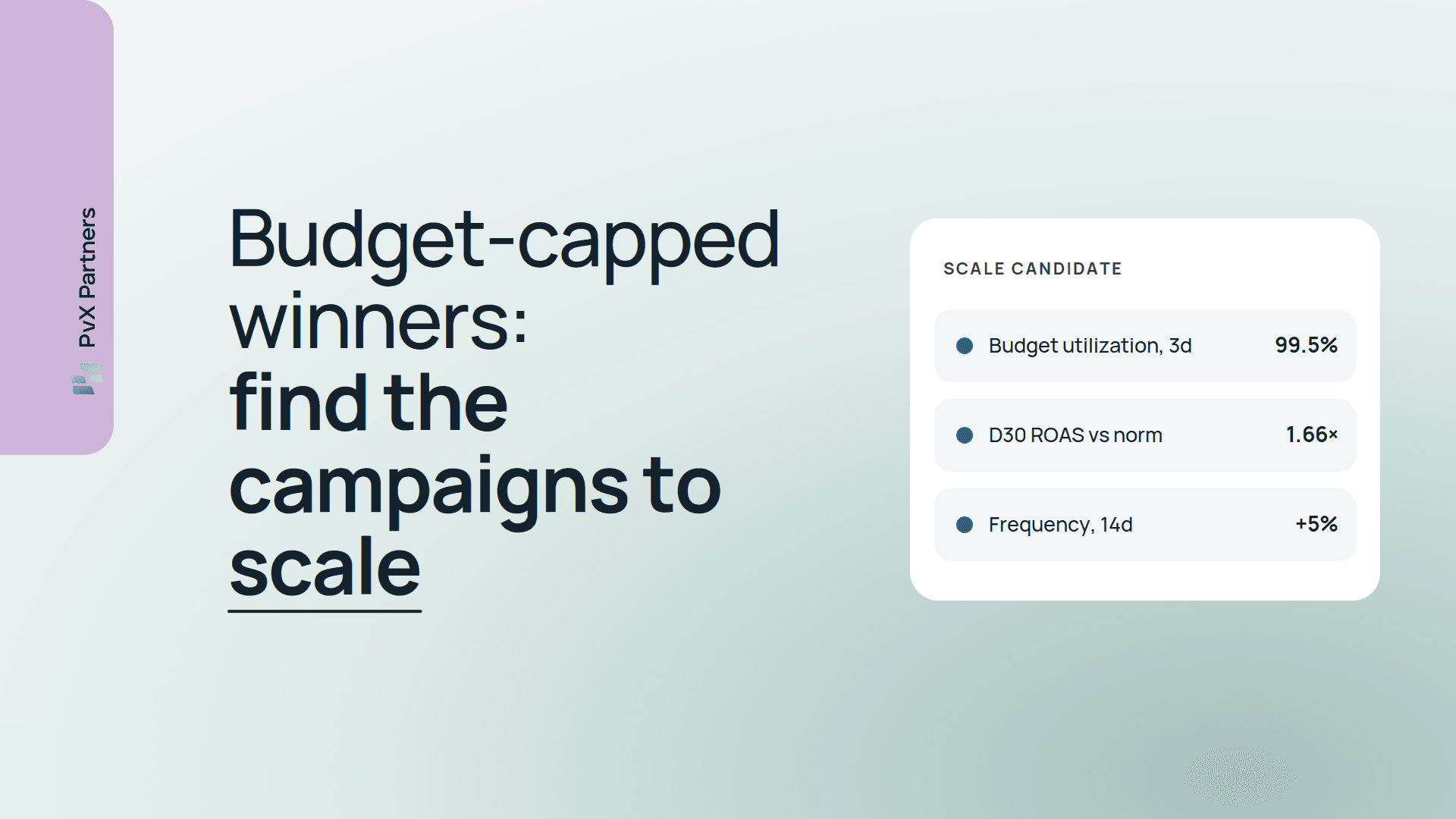
- 4. Budget-capped winners — spend ÷ budget ≥ ~95% for several days while cohort ROAS beats target. Why humans skip it: audits look for damage; nobody audits for money left on the table. Guide: budget-capped winners
- 5. Ad set failures inside healthy campaigns — every metric family at ad set level against its own baseline. Why humans skip it: the campaign average looks fine, especially under campaign-level budget optimization. Guide: ad set performance analysis
- 6. Creative fatigue on your top spenders — CTR vs the creative's own peak, creative age and IPM, with D7 ROAS as the tie-breaker. Why humans skip it: it needs ad-level history per ad set, and CPI only breaks weeks later. Guide: creative fatigue detection
- 7. Creative concentration — the top creative's share of spend and of installs. Why humans skip it: concentration feels like success until the creative fatigues and there's no successor. Guide: creative concentration risk
- 8. Spend change without a budget edit — spend vs baseline where no budget or bid changed. Why humans skip it: nobody watches for spend they didn't ask for. Guide: unexplained spend change
Tier 2: high value, easy to forget (9–17)
- 9. MMP vs network install divergence — the ratio of network-reported to MMP-attributed installs, per network and OS, against its own baseline. Why humans skip it: everyone knows the numbers differ, so nobody watches when the difference changes. Guide: AppsFlyer vs Meta Ads Manager install discrepancy
- 10. Store-side CVR break — click-to-install CVR dropping on every network on the same day. Why humans skip it: UA teams look at media; the store page is someone else's. Guide: click-to-install CVR
- 11. Top-five country trends — CPI, CPM, CVR and ROAS per top-five country, each against its own history. Why humans skip it: countries hide inside multi-geo campaigns. Guide: why is my CPI increasing?
- 12. Rest-of-world drift — all non-top-five countries pooled into one cluster and trended. Why humans skip it: each small market is too small to look at, so nobody looks at them together. Guide: tier-2 and rest-of-world analysis
- 13. Campaign ROAS vs peers — campaign Dx ROAS ÷ the norm for campaigns of the same role. Why humans skip it: comparing to yesterday takes a glance; comparing to peers takes a pivot table. Guide: benchmark campaigns against the account norm
- 14. Audience saturation — spend holding while impressions and new reach fall and frequency rises. Why humans skip it: it's four metrics read together, at ad set level. Guide: audience saturation
- 15. Frequency vs a role-specific norm — campaign or ad set frequency ÷ the norm for its role (prospecting vs retargeting). Why humans skip it: frequency has no universal "too high," so it never gets a rule. Guide: ad frequency too high?
- 16. Disapprovals weighted by spend — disapproved or limited ads × the spend share they carried. Why humans skip it: platform emails get filtered; a disapproved top ad is noticed only when delivery drops. Guide: ad disapproval monitoring
- 17. iOS vs Android, each against its own history — every metric family by OS. Why humans skip it: blended numbers hide an OS that's quietly getting worse. Guide: iOS vs Android divergence
Tier 3: weekly, upside and hygiene (18–25)
- 18. Network ROAS vs norm — network Dx ROAS ÷ the blended norm. Why humans skip it: network mix decisions get made quarterly, not weekly. Guide: network-level divergence
- 19. Rising geos — countries outside the top five with growing volume and ROAS at or above norm. Why humans skip it: upside checks never feel urgent. Guide: rising geos
- 20. Retention trend by campaign — D1 and D7 retention by acquisition cohort. Why humans skip it: ROAS gets the attention; retention moves first. Guide: retention drop by acquisition cohort
- 21. Creative × geo × network cross-cut — each creative's IPM and ROAS per country and network. Why humans skip it: it's the biggest table in the account; winners stay siloed in the market where they were launched. Guide: creative performance by country and network
- 22. Efficiency vs outcome in creative rankings — rank by IPM and by D7 ROAS, then look at the disagreements. Why humans skip it: most teams rank by spend. Guide: top and worst creative ranking
- 23. Concept and art-style rollup — metrics rolled up by concept parsed from creative names. Why humans skip it: it needs disciplined naming first. Guide: creative concept and art style
- 24. Month-end pacing — month-to-date spend projected to month-end ÷ planned budget. Why humans skip it: it gets checked, just late. Guide: budget pacing
- 25. Post-change review — did the last bid, budget or creative change work? Compare the 72 hours after against the baseline. Why humans skip it: once a change is made, attention moves on. Guide: measuring the impact of campaign changes
How to automate them without drowning
Turning these into automation takes five decisions:
- Write the formula down exactly. "CPI is high" isn't a check; "7-day CPI ≥ 20% above its own 28-day baseline, with ≥ $100/day spend" is.
- Gate every slice for volume and materiality before it can alert.
- Pick the cadence. Delivery metrics daily; cohort metrics, vs-norm comparisons and creative rankings weekly. Cohorts need time to mature. Why: daily vs weekly UA checks.
- Deduplicate by root cause. One network's CPM spike trips checks at account, OS, geo and campaign level at once. Without dedupe, one problem becomes six alerts.
- Rank by spend at risk × size of deviation × confidence, and send one short brief, not a stream of notifications. See spend at risk prioritization.
The three ways to build this — platform rules, an LLM with MCP, or an autonomous audit — are compared in how to automate campaign performance review. The complete list these 25 are drawn from is the mobile UA audit checklist.
Where PvX Delta fits
PvX Delta runs this kind of library every night across your MMP (AppsFlyer, Adjust or Singular) and Meta Ads and Google Ads. Access is read-only, through official APIs. The validity gate, deduplication and spend-at-risk ranking run on every pass, and the output is a morning decision brief. Eighteen of the 25 checks above run in Delta today. Seven aren't in Delta yet, because the data they need isn't available to it yet or the check is still under review: numbers 4, 9, 14, 15, 16, 24 and 25. For those, use the manual method in each linked guide. The full, current list is the PvX Delta check library. Delta is free and advisory: it tells you what to change, and you change it.
Stop running these by hand.
Free, read-only, official APIs.
See how PvX Delta works →
Sources
Related
- Spend at risk prioritization
- PvX Delta vs a manual UA audit