


The delivery signals that show an audience is exhausted (impressions down, reach flat, frequency up) at campaign and ad-set level, and what to do next.
Sep 25, 2026 - 7 minutes

By Sam Nam · PvX Partners
If your campaign's spend is steady but impressions are sliding, new reach has stopped growing and frequency keeps climbing, you are looking at audience saturation: the budget is re-buying the same people because the pool is too small for the spend level. It is a delivery constraint, not a creative or bidding problem, and it compounds. Saturated users stop clicking, CPM rises as the algorithm pays to re-reach them, and CPI breaches a week or two later. Detecting audience saturation at the delivery stage lets you fix it before those downstream alarms fire.
In this guide: What it costs · The signature · By dimension · False positives · What to do
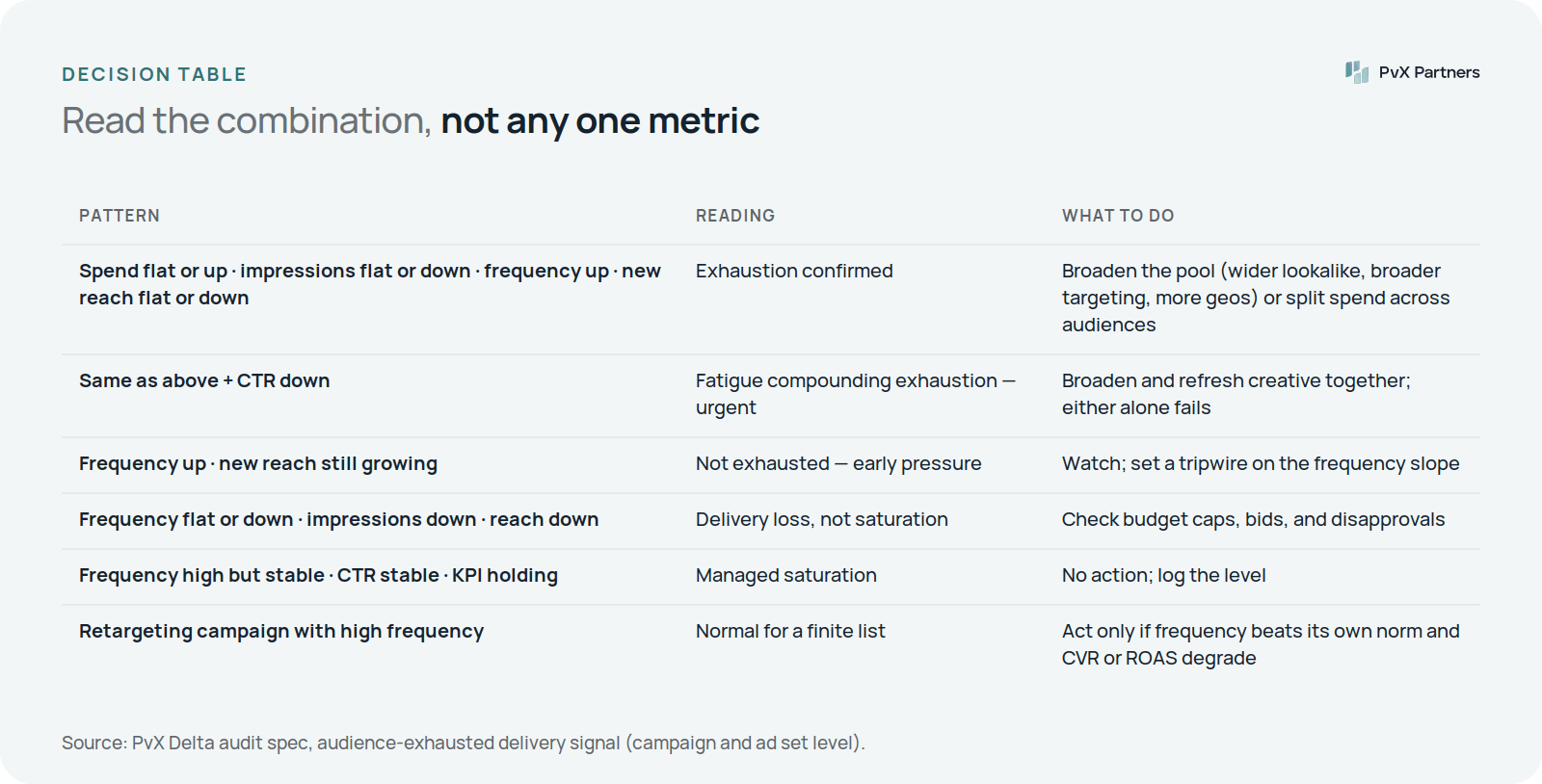
Audience saturation happens when a campaign or ad set has reached most of the people it can reach at its current targeting, and additional spend mostly buys repeat impressions to the same users. The confirmed signature is a conjunction of four delivery signals, read together:
Any one of these alone has other explanations. Impressions can fall because a bid got uncompetitive; frequency can rise because a retargeting list is finite by design. It is the combination that says "this pool is used up."
Meta surfaces saturation-style warnings in Ads Manager, but they sit at the ad set level and don't tell you whether the problem is local to one audience or systemic across siblings. The delivery-signal method works on any network that reports impressions and reach, at campaign and ad set depth, and lets you compare an entity against its own history rather than a platform's generic rule.
From the PvX Delta audit spec's sample results (a fictional account; illustrative numbers). A Japan iOS campaign running on a 2% lookalike, 14 days versus the prior 14 days:

Spend held flat rules out pacing, budget caps and bids. That leaves the pool. Illustrative data.
Because spend held flat, the usual delivery suspects — pacing, a budget cap, a bid falling behind the market — are ruled out. Every dollar is buying fewer impressions and fewer new people. The falling CTR says creative fatigue is now compounding the saturation: this is the urgent version. The pool math is simple: a 2% lookalike of Japanese iOS users is too small to absorb $290 a day at a frequency below 3.
The frequency norm must be role-specific. UA prospecting and retargeting behave differently; in the spec's sample, a UA prospecting norm sits around 2.0, while retargeting is judged only against its own history. Never compare a retargeting campaign's frequency to a prospecting campaign's.
Saturation rarely shows at the aggregate. A healthy prospecting campaign will mask a saturated one. Account-level frequency rising slowly while CPM rises is a hint to go down a level, not a finding in itself.
Pool size varies by network. The same lookalike seed yields very different reachable audiences on Meta than a tROAS campaign does on Google, where Google's automation chooses inventory across Search, Play, YouTube and Display. On Google App Campaigns you have fewer targeting levers. There, saturation shows as rising CPM and flattening installs while spend holds, and the fix is usually more geos or creative variety rather than a wider audience setting.
Smaller markets saturate first. A country-specific campaign in a mid-size market can exhaust in weeks at a budget that would be trivial in the US. If only one country shows the signature, the fix is local: cap spend there or broaden the audience in that market alone.
This is the main reading level. Also check for sibling overlap: two campaigns chasing the same users push both frequencies up while combined reach stays flat. If two lookalikes built from similar seeds are both climbing in frequency, add mutual exclusions before broadening either one.
Inside a campaign using campaign-level budget optimization, the algorithm can concentrate spend on one ad set until that audience saturates while the campaign average looks fine. Read the signature at ad set depth, and check which ad set's frequency is rising fastest per dollar.
If your naming convention encodes audience type (broad, LAL 1%, LAL 5%, interest), you can compare frequency across audience types account-wide. Small lookalikes and tight interest stacks saturate first; broad rarely does. This only works if names are parseable — see campaign naming conventions and audience performance analysis.
The frequency side of this is covered in more depth in ad frequency too high?, and the reach side in reach declining but impressions aren't.
PvX Delta runs its audience-exhausted delivery check daily at campaign and ad set level (spec A05.20, A06.16), testing the full conjunction — spend, impressions, net new reach and frequency — rather than any one signal. Weekly, it compares each campaign's, ad set's and parsed audience type's frequency against a role-specific peer norm (A05.22, A06.17, A08.13), with retargeting judged only against itself. When CTR is decaying alongside, the finding is escalated as the urgent variant and linked to the creative pass. Results arrive in the morning decision brief. Delta is advisory: it names the saturated pool and the fix, and you make the change.
Delta runs this check nightly — connect your data. Free, read-only, official APIs. See how PvX Delta works →

Oct 15, 2026 - 15 minutes

Oct 02, 2026 - 15 min
Sep 29, 2026 - 15 min
Some of the fastest growing businesses in the industry