

A fresh guide to what UA financing is, how it works, and whether your studio is ready for it.
Oct 08, 2026 - 5 min read

We created a new guide for studios exploring user acquisition (UA) financing for the first time or looking for a refresher. The market for UA and overall funding has shifted in the past year:
This guide is split into two parts: Part 1 covers the basics of what UA financing is, how it works, how to tell whether you’re ready, and how it compares with other ways to fund your growth. Part 2 covers what happens once you’ve gotten started with UA financing.
At PvX, our aim is to provide studios with more than just capital; we also want to help them to use their capital effectively by providing analysis and advice, especially for newer studios entering a tighter funding market. UA financing isn't only another source of money. It's a different way to grow: you fund expansion from the performance of what you've already built, rather than giving up ownership to do it.
¹Adjust, Gaming App Insights Report 2026 https://www.adjust.com/resources/ebooks/gaming-app-insights/
²AppsFlyer, State of Gaming for Marketers 2026 https://www.appsflyer.com/company/newsroom/pr/gaming-marketing/
³Aream & Co. (2026, July 13). Video game market update: Q2 2026 Industry report, InvestGame https://investgame.net/news/pdf/video-game-market-update-q2-2026/
UA financing is growth capital that pays for your UA spend and is paid back by the revenue those users go on to generate. Two of the main advantages of UA financing are that it's non-dilutive and the downside is shared. You don't give up any ownership in your company and there’s no fixed repayment schedule, so if a cohort underperforms you aren't left covering the gap from your own cash.
Publicly listed mobile gaming companies spend a median of 34% of gross revenue on paid UA⁴, and smaller studios can spend roughly 50% or more of gross revenue. At that level, UA is no longer just a marketing line item. It's one of your biggest capital allocation decisions and it directly shapes how fast your revenue grows. That makes how you fund it as important as how you spend it. Of the funding options out there, UA financing is the only option built for how UA actually works: it provides the capital you need upfront and is repaid from the revenue your new users generate.
⁴PvX Partners analysis of 3,000+ cohort metrics, published in InvestGame, Enabling Growth: Cohort User Acquisition Financing (August 2025), p. 4 https://investgame.net/wp-content/uploads/2025/08/2025_Aug_InvestGame_Enabling_Growth_UA.pdf
The core idea behind UA financing is that it relies on your UA performance data: historical cohort return on ad spend (ROAS) curves, retention, payback periods and customer acquisition cost (CAC). A cohort is the group of users acquired in a given month. This data is usually pulled from your mobile measurement partner (MMP), such as AppsFlyer or Adjust, and your app store revenue. Based on that data, it is possible to predict how reliably those cohorts will perform in the future, which determines whether you qualify for UA funding and how much you can receive.
This works once your app or game has found product-market fit, since that's when early cohort data becomes a reliable signal of future revenue. Capital is then advanced against the predicted revenue of the cohorts you're about to acquire and repaid on their actual revenue rather than a fixed schedule. That's also what separates UA financing from a loan: the capital is secured against the performance of the cohorts it funds, not your company, your IP or your balance sheet.
Here's what the process looks like, step by step:
The result is a flywheel: stronger cohorts unlock more capital, which funds more UA, which generates more revenue and more cohort history. Studios that get this loop right can scale without giving up equity for growth capital, freeing up their own cash for other priorities like product development, new titles, hiring and operations.
To get that flywheel going, you first need cohorts that a financing partner is confident will pay back. The question they're trying to answer is whether your cohorts are likely to pay back the money advanced against them, and with what margin of safety. Strong candidates usually have:
If you don't tick these boxes yet, building your measurement infrastructure and your performance is where to start. Most studios fund their early growth through other means before they have the cohort history UA financing requires, and each option fits a different stage and set of trade-offs.
There are several ways to finance UA, and while they can look similar, they're secured, repaid and priced differently. Here's how the main options compare:
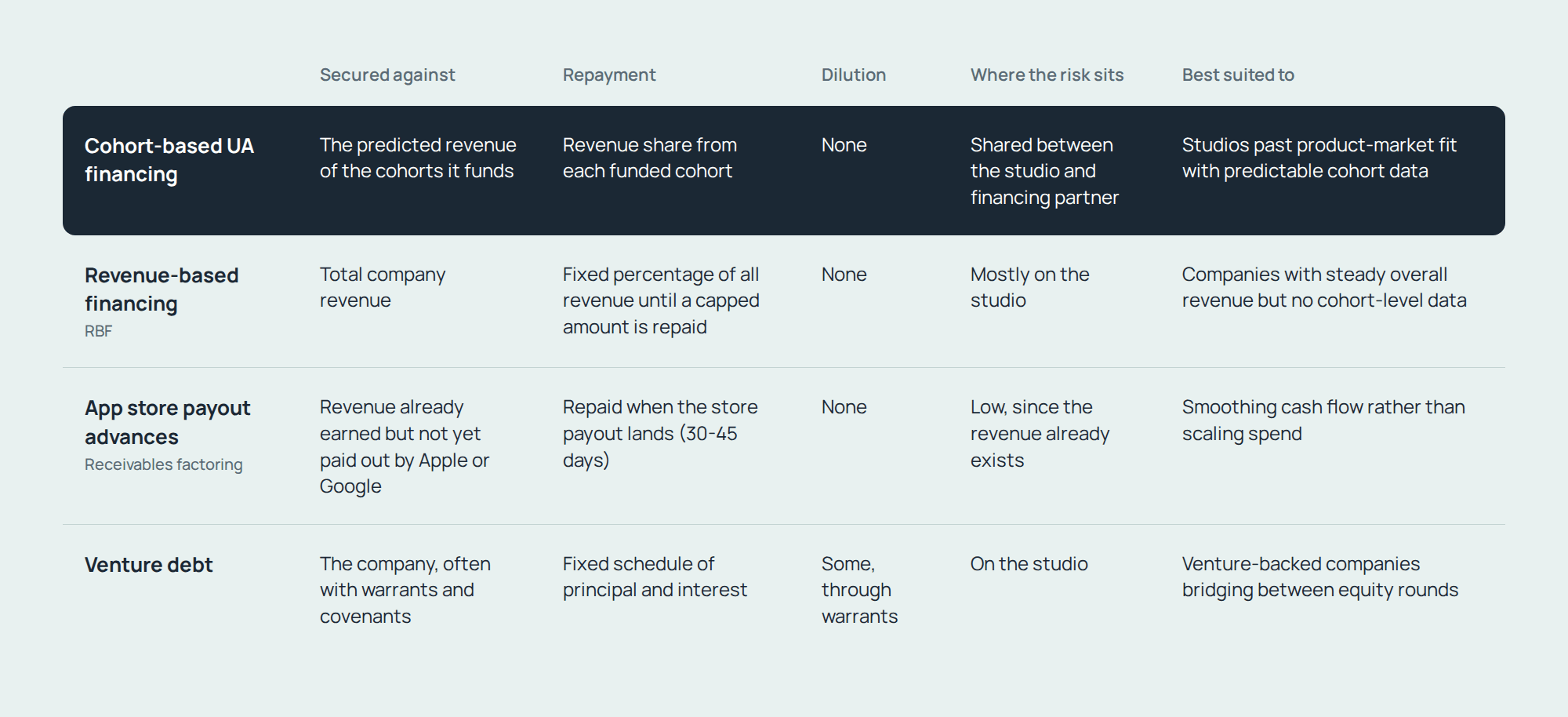
Cohort-based financing is the only option where repayment is tied to how the funded spend actually performs making it the only one truly built for scaling UA.
Equity can be the right fit in the early stages, when you don't yet know how your product will perform and your investors take on that uncertainty with you. But once your cohorts are predictable, funding UA with equity means paying venture-style prices for bond-style risk. (We cover this in more detail in The Right Financing at the Right Stage.)
Say a studio spends $1M a month on UA, or $12M a year. To fund that year with equity, it raises $12M at a $48M pre-money valuation and gives up 20% of the company. If the studio later exits at $300M, that 20% is worth $60M, so the $12M of UA ended up costing five times its face value. With cohort-based financing, the financing partner would cover 80% of that spend ($9.6M), while the studio covers the remaining $2.4M. At an indicative fee of 7%, that would cost about $672K, and the founders keep all of their equity.
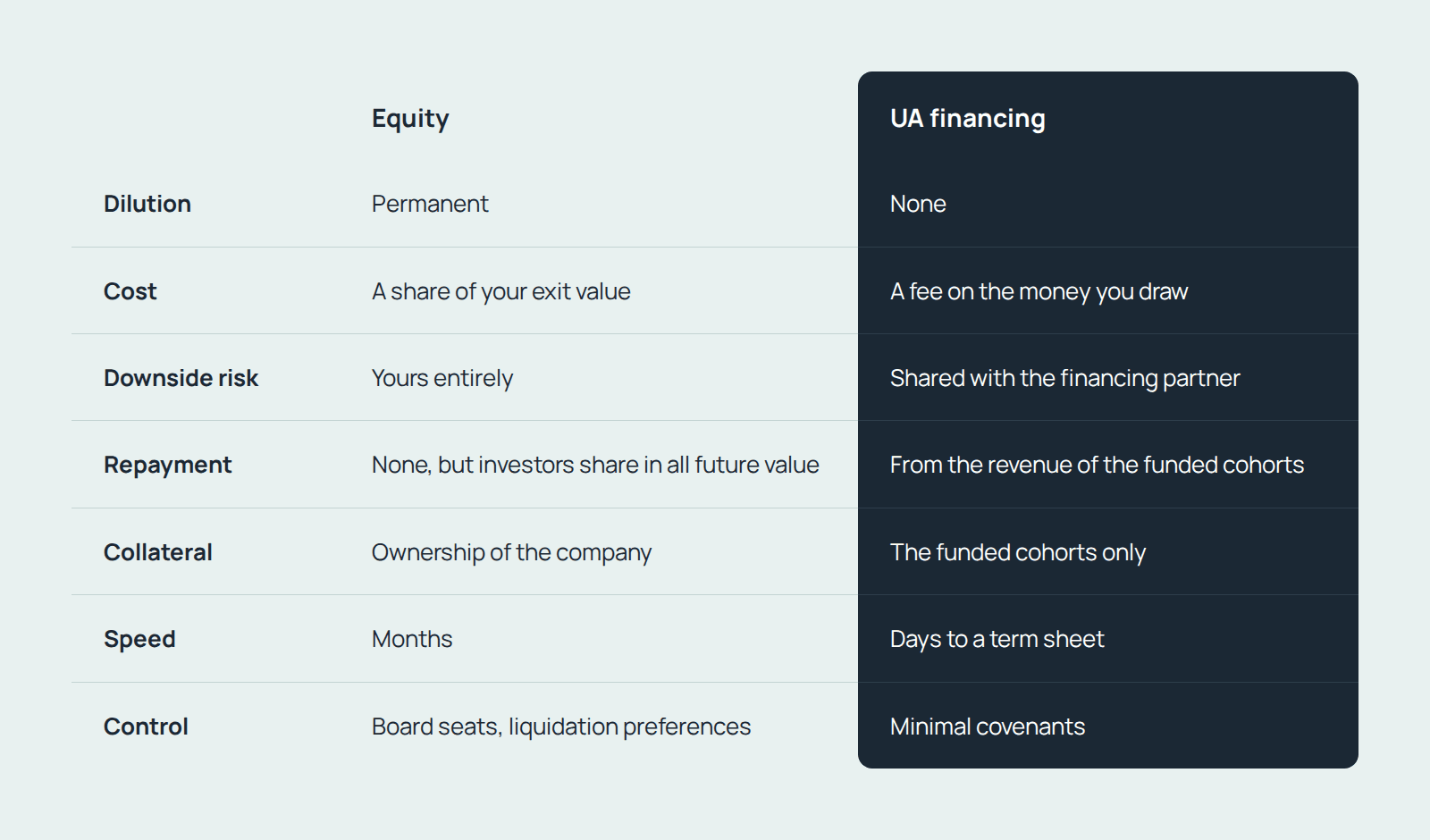
Here is a quick recap of the difference between equity and UA financing:
Not all studios are ready when they first look into it, and that's fine. The groundwork you lay now still counts. Tracking your cohorts cleanly, understanding your ROAS curves and benchmarking your retention against similar titles will help you spend more efficiently today, and it will put you in a stronger position once you're ready to apply. PvX Lambda is built for this: it benchmarks your cohort performance, projects how your cohorts are likely to pay back, and shows how close you are to qualifying for funding.
Once your cohorts are there, Part 2 covers what comes next: deploying your first drawdown, what happens when a cohort underperforms, and how far you can scale from there.
Some of the fastest growing businesses in the industry