

A look into how gaming and consumer apps have been solving the similar problems in different ways.
Jun 05, 2026 - 2 min read
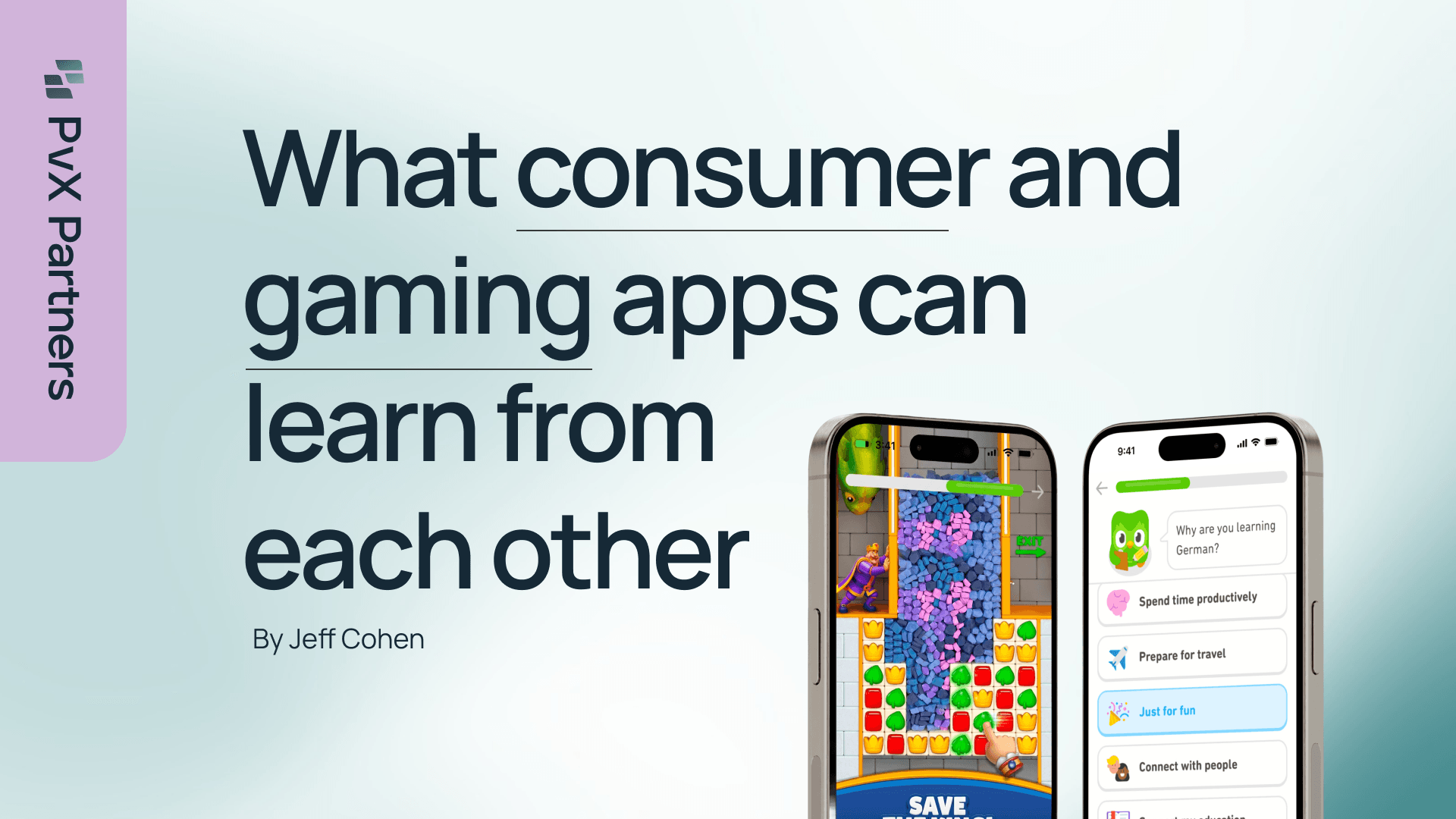
The convergence of gaming and consumer apps has become one of the most consistent themes I hear discussed. Gaming VCs are pivoting to writing checks into consumer apps; app companies are hiring talent out of mobile studios. The line between “a game” and “a gamified consumer app” is becoming increasingly blurred.
It's pretty well understood and become a "VC cliché" to say that these two ecosystems can learn a lot from one another. PvX sits at the intersection of these two sectors, with about half of our portfolio in gaming and half in consumer apps. It’s been surprising to me to see that the conversation rarely goes deeper than surface level. Where exactly can each side benefit from learning from the best practices of the other? Based on my experience speaking to hundreds of the best of both worlds, here’s my point of view.
84% of all mobile IAP revenue in 2024 came from games running live ops, and 95% of studios are now running or building a live-service title. Seasonal content, limited-time events, and a predictable cadence of fresh reasons to open the app are standard in gaming and less common in consumer.
Gaming UA teams run a fundamentally more advanced creative operation. Playable ads, rewarded UA, and "fake ad” creatives are standard practice in gaming and barely touched in consumer.
Levels, streaks, leaderboards, tiers, public status, these are very useful psychological tools that increase retention. Top consumer apps (like Duolingo) that have figured this out tend to dominate retention in their categories. However, they tend to be more commonly used in games.
Clans, guilds, alliances, co-op modes turn a solo experience into a social obligation. Again, top consumer apps such as Strava’s clubs, have utilized this with great results but they are less commonly seen in apps vs games.
Games run actual economies; virtual currencies, sinks that pull currency back out of circulation, faucets that put it in, careful balancing to keep payers spending and non-payers progressing. Consumer apps mostly sell subscription SKUs. The discipline of running a closed economy unlocks deeper monetization from your most engaged users that a flat subscription can't reach.
Gaming has treated Discord, Reddit, and forums as core infrastructure for years. The community is a live feedback loop, a retention driver, and an early warning system all at once.
To be fair, gaming has started making its own move toward direct-to-consumer monetization, designed to recapture margin on existing payers by sidestepping the app store's 30% cut. But that's web as a back-end monetization surface: get the user into the app, then route them to a webshop for cheaper IAPs. Consumer apps have taken a different approach, web as the front of the funnel. A landing page, a web onboarding flow, then a handoff to the app. Same underlying insight (don't let the store own the relationship), very different application. Games are using web payments to widen the margin on users they already have whereas consumer apps are using it to acquire users in the first place. The structural advantages (first-party data, payment relationship, lower CAC) compound long after install.
Consumer app onboarding is often a series of deliberate questions used to shape the first session. Games will typically run every new user through the same scripted tutorial, regardless of where they came from or which creative they clicked (note: this is not the case for the most sophisticated games). If you paid for a user off a hyper-specific ad, dropping them into a generic FTUE is a good way to lose the cohort you just bought.
Consumer apps have made referral a core product surface, not a marketing afterthought. Duolingo's friend streaks turn invites into a retention mechanic. Calm's "gift a friend a free month" makes the invite feel generous. Robinhood, Cash App, and Revolut built entire growth curves on referral baked into the product flow. The pattern: the invite isn't buried in settings, it's a feature the user wants to use because it makes their own experience better.
Consumer apps treat email, push, SMS, and in-app messaging as a coordinated system, with behavioral triggers, win-back flows, and proper segmentation running on platforms like Braze or Iterable. Most games barely use email at all and treat push as a blast channel for re-engagement campaigns.
Some of the fastest growing businesses in the industry