


Most studios don't know what their ROAS target should be. Here's the framework.
May 28, 2026 - 5 min read
When I used to consult developers on user acquisition, the very first question I asked was always the same: "What is your ROAS target?"
The range of answers I got told me almost everything I needed to know about the maturity of a studio's UA operation. Some founders would name a number confidently. Most couldn't. Here's how it typically went:
Most early-stage developers have no idea what the right ROAS target should be — and the ones who think they do are often not much better off.
What is a ROAS payback period? The ROAS payback period is the number of days it takes for a user cohort to return 100% of its acquisition cost in net revenue. It is a foundational metric in any user acquisition financing framework, the threshold that determines how aggressively a studio can deploy marketing spend capital.
In practice, I see studios land on their ROAS target in one of three ways:
None of these approaches are wrong in the sense of being irrational. But none of them give you a defensible, data-backed reason for your target. That matters more than you might think: without a principled ROAS target, you cannot know whether you're underinvesting (leaving growth on the table) or overinvesting (burning cash on cohorts that won't return). This is the core problem in mobile app user acquisition financing, the threshold that governs your entire spend strategy is often set by feel.
Here's the process that actually works.
This is a finance and policy decision, not a UA team decision. It sits upstream of everything else.
The question to answer: "Given our cash position, our payout cycle, and our cost of capital, what is the maximum number of days we can wait before a cohort fully pays back its acquisition cost?"
A concrete example: "Considering our bank balance and our app's payment cycle, we need to hit 100% ROAS within 120 days for all UA campaigns."
This threshold is typically set by finance and revisited quarterly. The inputs that drive it are:
The output of Step 1 is a single number: your recoup period, in days, and a corresponding full-recoup ROAS target (almost always 100%, sometimes higher if you're building in a margin buffer).
Your UA team cannot manage to a 120-day ROAS target in real time. By the time you know whether a cohort hit 120-day ROAS, you've already been spending for four months. You need an early-day proxy — a D7, D14, or D30 ROAS target that is mathematically consistent with hitting your 120-day threshold.
This is where the work gets technical, and it's where most studios fail.
A concrete example of what the output looks like: "Hit D30 ROAS of 40%. If you're hitting it, spend as much as you want. If you're not, immediately scale back."
The math underneath this is predictive LTV (pLTV) modeling: you forecast the full revenue curve of a cohort from early behavioral signals, then invert that curve to find the early-day ROAS that is statistically consistent with hitting your recoup threshold at Day N.
The mechanics:
The operational rule that falls out of this: spend as much as you can, as long as your UA team is hitting the proxy ROAS target. The moment they miss it, cut spend immediately. This sounds simple. It is extraordinarily difficult to execute because most studios don't have the data infrastructure to monitor proxy ROAS in near-real-time, and because the political pressure to "keep spending" is intense when growth is the top priority.
This is the step most frameworks leave out entirely.
Knowing your ROAS target tells you which cohorts are worth acquiring. It does not tell you how much total capital you can deploy. Those are different questions.
Your maximum deployable UA budget in any given period is constrained by:
For most studios, this produces a hard ceiling on organic UA spend that is much lower than their growth ambition. This is precisely the gap that non-dilutive UA funding is designed to fill — not to let studios spend recklessly, but to let studios whose proxy ROAS targets are being hit consistently deploy more capital than their cash position would otherwise allow, without giving up equity.
UA financing is not a substitute for a working ROAS framework. It's an accelerant for studios that already have one. If you don't know your recoup threshold, don't know your pLTV curve, and aren't monitoring proxy ROAS in real time, more capital will not save you. It will just help you fail faster.
If your ROAS math is sound, the constraint is purely capital — and that's a much better problem to have.
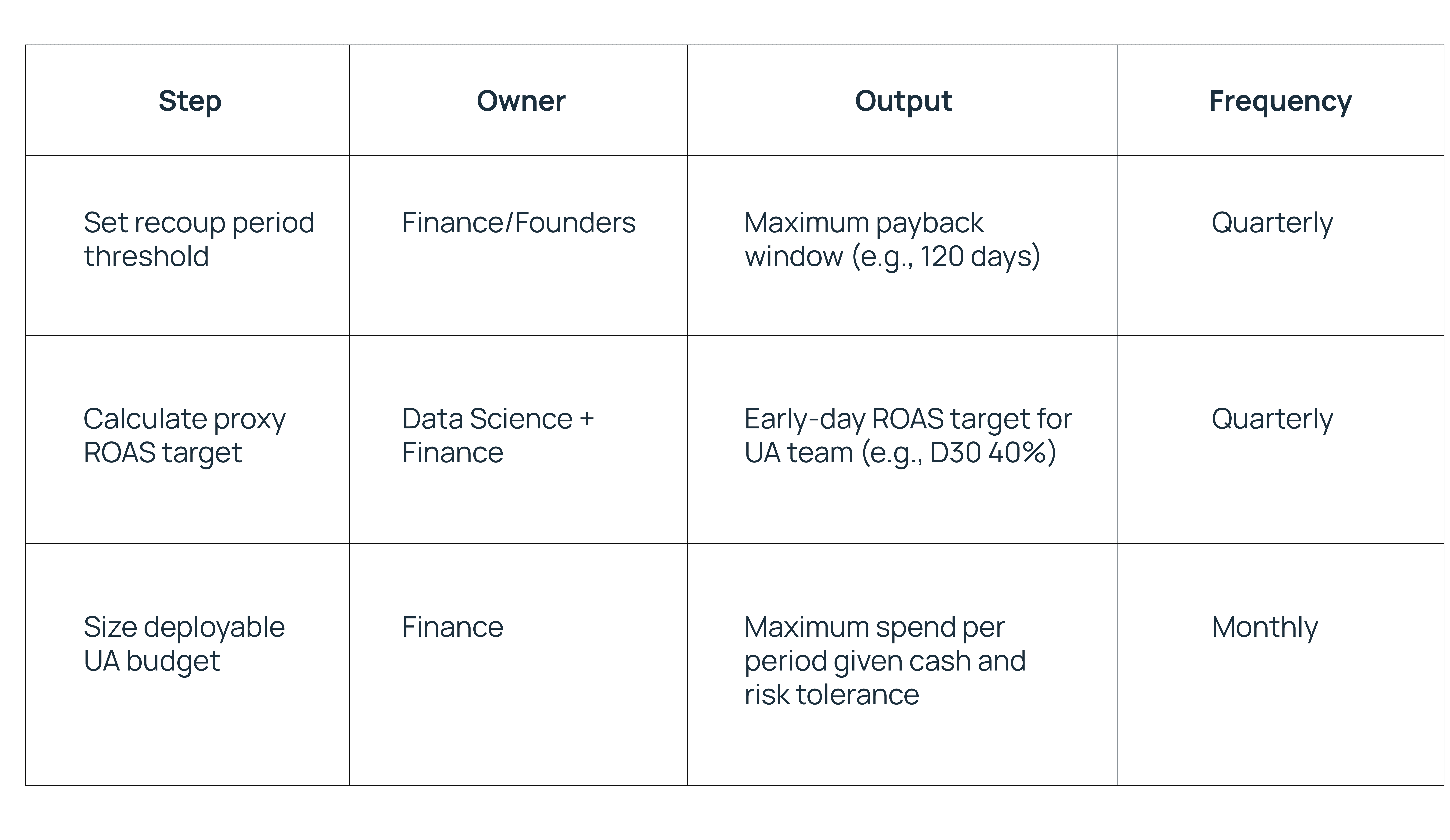
Most studios operate with a vague intuition about one of these three pieces. The studios that compound efficiently have all three locked in, revisited regularly, and connected to each other in a coherent model.
The ROAS payback period calculation is not a UA question. It's a capital structure question. Answer it that way, and your UA team will finally have a target that means something.
What is a ROAS payback period?
The ROAS payback period is the number of days required for a user acquisition cohort to return 100% of its acquisition cost in net revenue. It is the central metric in any UA financing or user acquisition financing framework — the threshold that determines how aggressively a studio can deploy marketing spend capital without jeopardizing cash flow.
How do you calculate a ROAS payback period?
The calculation has three components: (1) set a recoup period threshold in days, based on your cash position, app store payout cycle, and cost of capital; (2) fit a revenue curve to historical cohort data to find the ratio of early-day ROAS to your target recoup ROAS; (3) set a proxy ROAS target at the lower confidence bound of that curve — not the point estimate — to build downside protection into the model. This is the core of any data-backed mobile marketing payback period framework.
How does non-dilutive UA funding relate to ROAS targets?
Non-dilutive UA funding — also called cohort financing or user acquisition financing — is sized by a financing partner based on whether a studio's early-day ROAS signals are hitting a defensible proxy target. Studios with a working ROAS framework can access more app growth capital, and deploy it faster, because the cohort data provides the underwriting basis. Studios without one are not fundable — and should not be spending at scale regardless.
Some of the fastest growing businesses in the industry