


Meta app install ads analysis with PvX Delta: nightly checks on app install and Advantage+ app campaigns, ad set and creative level, joined to MMP cohort ROAS.
Oct 19, 2026 - 5 minutes
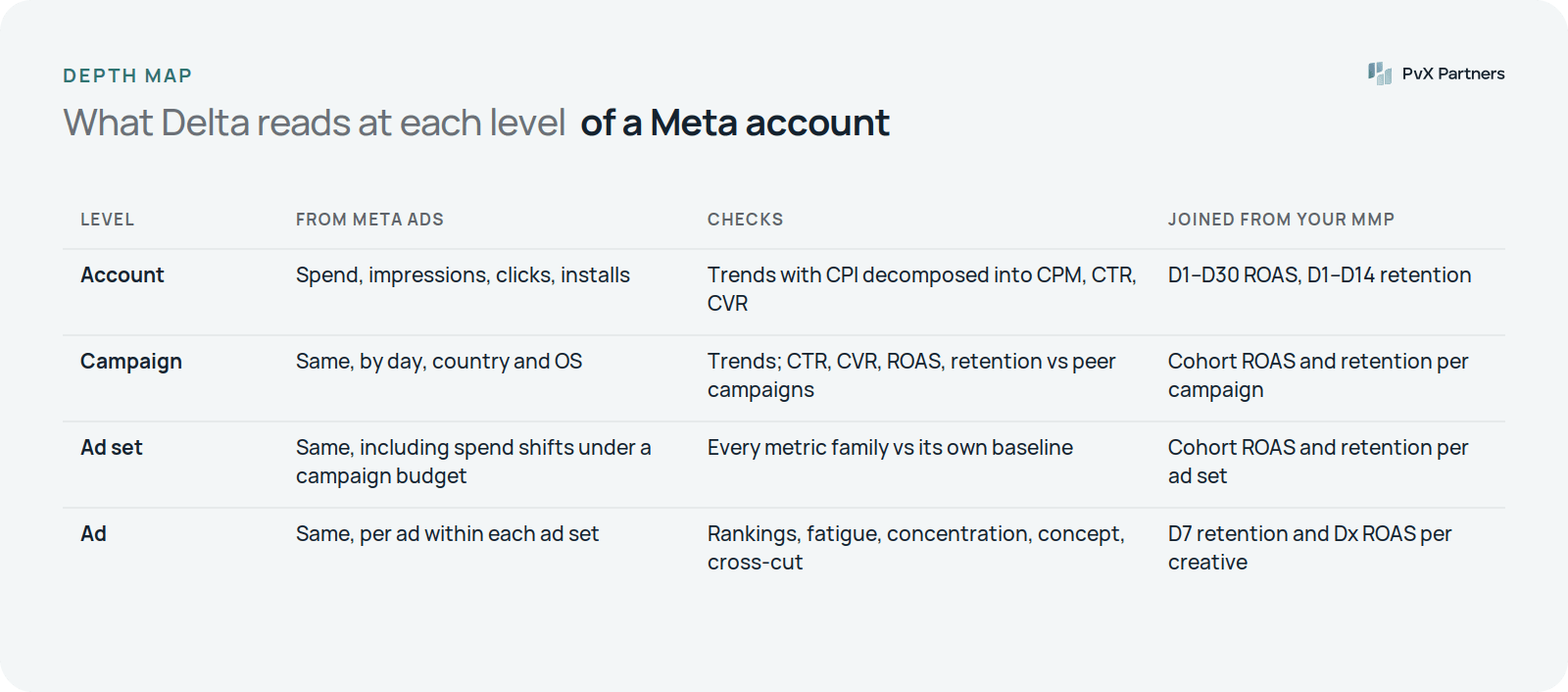
Meta app install ads analysis usually happens in two tabs: Ads Manager for delivery, and your MMP for what those installs were worth. PvX Delta puts them in one context and audits them every night. From Meta Ads it reads spend, impressions, clicks, installs, CPM, CTR, CVR and IPM at campaign, ad set and ad level, for manual and Advantage+ app campaigns. From AppsFlyer, Adjust or Singular it reads D1–D30 ROAS and D1–D14 retention by cohort. It runs 100+ deterministic checks across both and leaves a decision brief for the morning. Access is read-only through Meta's official Marketing API. Delta is free and advisory: it tells you what to change in Ads Manager, and you make the change.
From your MMP, Delta joins D1–D30 ROAS and D1–D14 retention for the same campaigns, ad sets and ads. Meta's reported installs and your MMP's attributed installs will differ; why, and which to use for what, is covered in AppsFlyer vs Meta Ads Manager install discrepancy.
Meta-specific checks that need both datasets
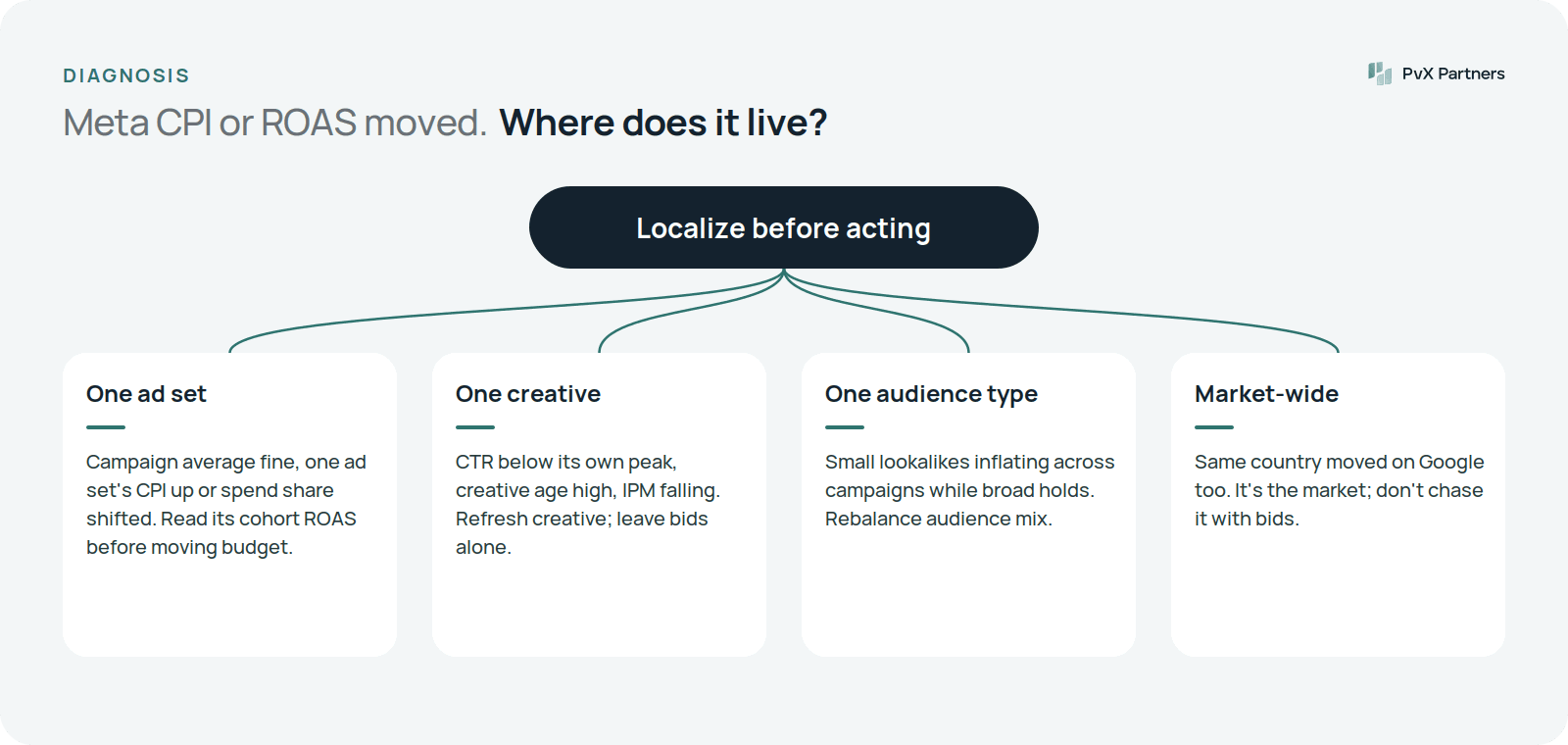
With a campaign-level budget (Advantage campaign budget), Meta decides how spend is split between ad sets. Campaign averages can look fine while one ad set's CPI climbs and Meta quietly moves money toward or away from it. Delta runs every metric family at ad set level, including the spend trend, so a sudden reallocation shows up as a finding. It then reads that ad set's cohort ROAS from your MMP to tell you whether the reallocation helped or hurt. See ad set performance analysis.
Meta gives you ad-level delivery, which is enough to read creative fatigue properly: CTR against each ad's own peak, creative age within the ad set, and IPM. Delta adds the outcome side, D7 ROAS on matured cohorts, to decide whether a decaying ad still pays. In an illustrative example from our spec's samples, Meta CPI rose 14%, entirely through the CTR leg. Two hooks aged 52 and 47 days were carrying 71% of Meta spend. The brief said to refresh creative and leave bids alone. See creative fatigue detection.
If your names encode audience type, Delta compares broad, lookalike, interest and retargeting audiences across every Meta campaign at once. Small lookalikes tend to inflate in cost first; broad and Advantage+ audiences behave differently. Comparing like with like across campaigns is the check that's hardest to do in Ads Manager, because Ads Manager doesn't know what your naming means. See audience performance analysis.
Delta reads Meta alongside Google Ads and your MMP. When Meta CPM rises, it checks whether the same country moved on your other networks too. A move on Meta only is a Meta-specific auction or delivery issue. A move everywhere in one country is the market, and chasing it with bids rarely pays.
Advantage+ app campaigns (formerly automated app ads) hand most of the targeting and delivery decisions to Meta. Meta is also folding manual and Advantage+ setup into a single campaign-creation flow. With fewer levers, your job shifts from configuring campaigns to watching what the system does with them.
What you can still read, and Delta checks:
That last comparison is the one Meta's own reporting can't make for you, because it doesn't see your MMP cohorts. Background: Advantage+ app campaigns analysis.
Meta's official Ads MCP lets an AI assistant query and manage your ad account on request. For one-off questions it's good, and we'd use it. What it doesn't do on its own:
PvX Delta vs Claude + Meta Ads MCP compares the two honestly, including where the DIY route wins.
Get tomorrow's brief on your Meta app campaigns.
.png-j99mmp.png)
Oct 22, 2026 - 7 minutes
Oct 19, 2026 - 6 minutes
Oct 19, 2026 - 8 minutes
Some of the fastest growing businesses in the industry