


Google App Campaigns analysis with PvX Delta: nightly checks on tCPI and tROAS campaigns joined to MMP cohorts, and what you can see when Google automates.
Oct 19, 2026 - 5 minutes

Google App Campaigns (once called UAC) automate almost everything you'd normally tune by hand. Google chooses the bids, the inventory across its properties and the asset combinations. You set the budget, the bidding target, the locations and languages, the conversion event and the assets. With so few levers, Google App Campaigns analysis becomes the whole job: watching what the system does with your money and catching the moment it stops working. PvX Delta does that every night. It reads campaign and ad group delivery from Google Ads through the official, read-only API, joins it to D1–D30 ROAS and D1–D14 retention from AppsFlyer, Adjust or Singular, and runs 100+ deterministic checks. Delta is free and advisory: it tells you what to change, and you change it.
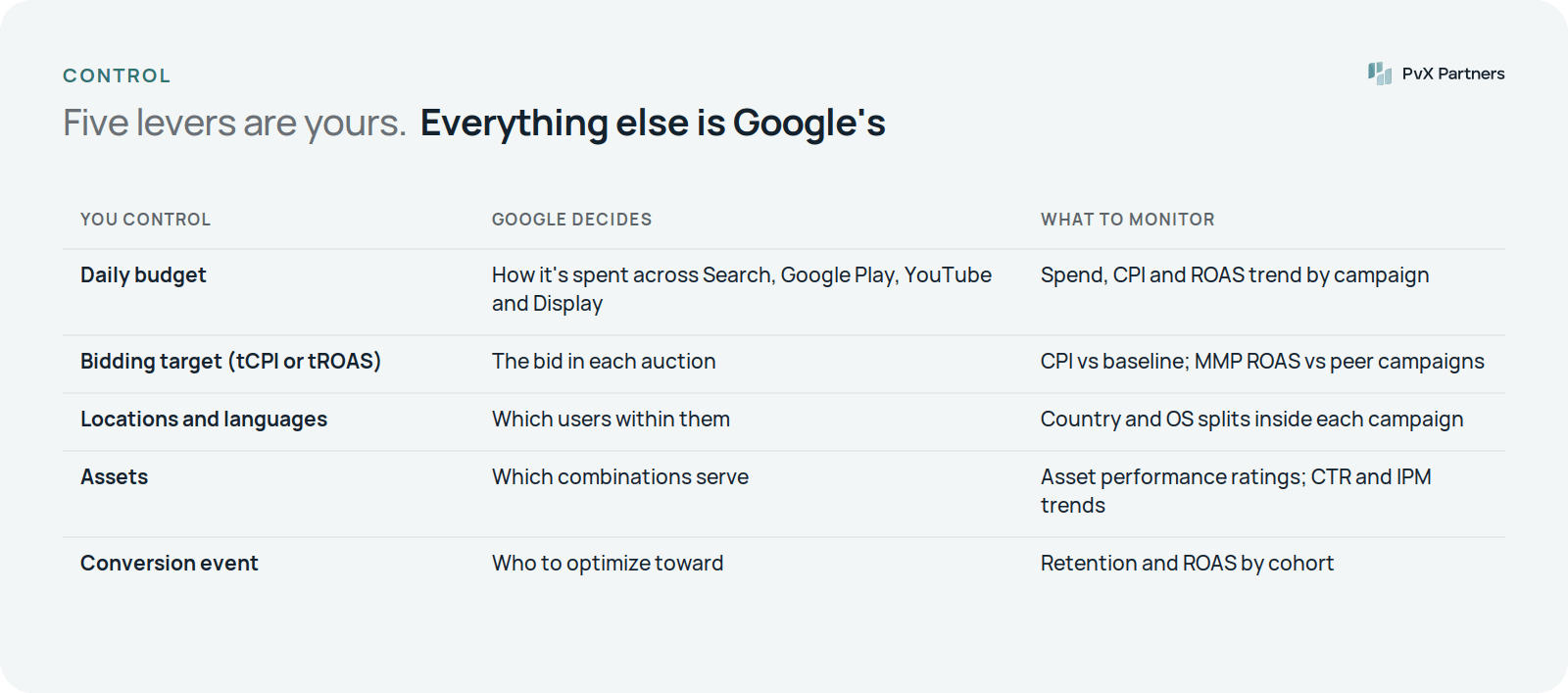
That split decides what a useful audit looks like. There's no point checking a keyword or an audience setting that doesn't exist. What you can do is watch the outcomes of Google's choices closely enough to know when to move one of your levers:
From your MMP it joins D1–D30 ROAS and D1–D14 retention for the same campaigns, on matured cohorts.
Creative depth is where Google differs most from Meta. Google's asset reporting for App campaigns centers on each asset's performance relative to other assets of the same type ("Low," "Good," "Best," or "Learning"), not ad-level delivery the way Meta reports it. So on Google, Delta's creative pass is thinner than on Meta, and campaign and ad group checks carry more of the weight. We'd rather say that plainly than imply otherwise.
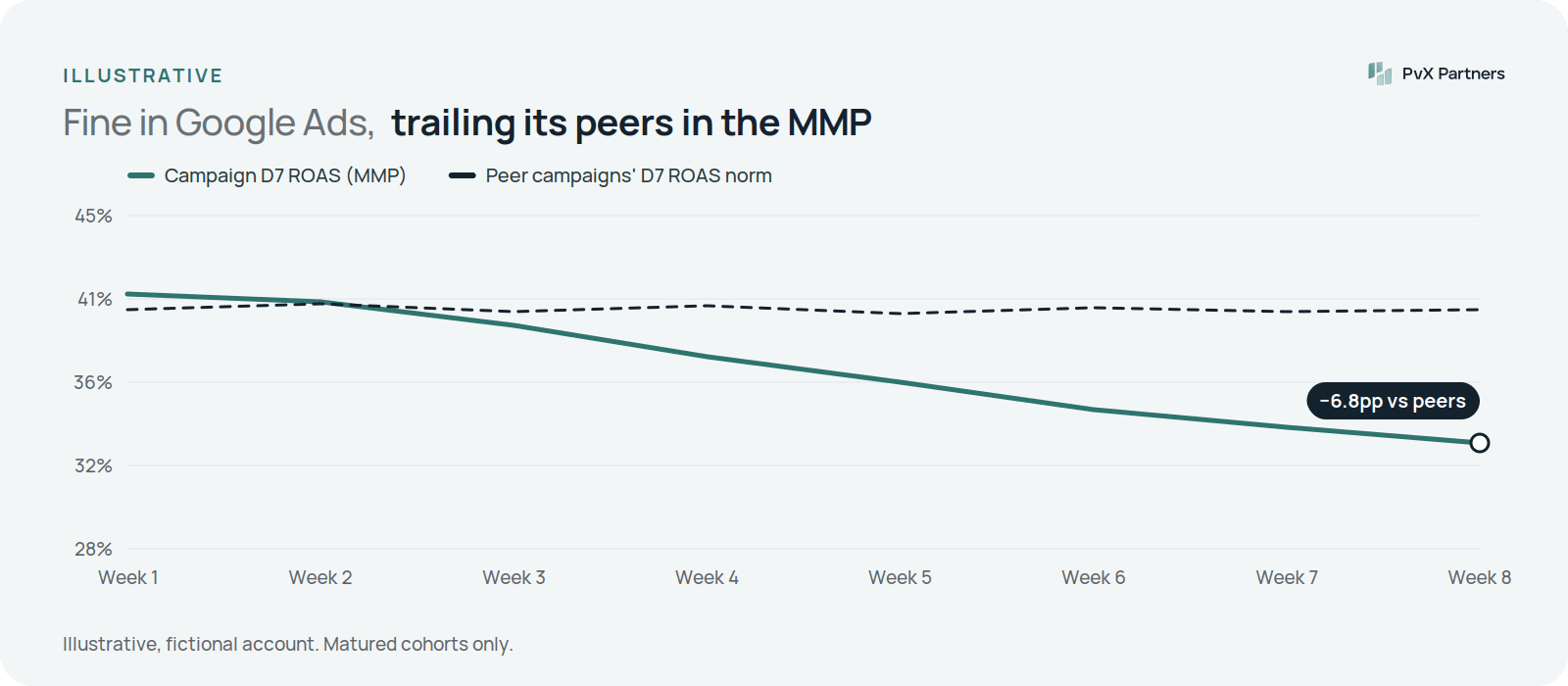
Google bids toward the conversion value it can measure and model. Your MMP measures cohort revenue on its own attribution rules. The two can drift apart, especially on iOS and on campaigns where Google's modeled conversions do a lot of work. Delta reads each Google App campaign's D1–D30 ROAS from your MMP every night and compares it with two things:
How to set the target in the first place is in tCPI vs tROAS for Google App Campaigns.
Because Delta reads Google, Meta and your MMP together, it can tell you whether a Google CPI rise in Japan is a Google problem or a Japan problem. If Meta's CPM in Japan rose on the same day, it's the market. If only Google moved, look at Google: a budget or target change, or an inventory shift toward pricier placements. See Meta vs Google App Campaigns performance.
Multi-country Google App campaigns blend markets with very different economics. Delta breaks every campaign's delivery and cohort metrics down by country (top five by name, the rest pooled) and by OS. A campaign whose average ROAS is fine can still be losing money in one country that deserves its own campaign, or its own budget. See rising geos and iOS vs Android divergence.
Google's recommendations tab and optimization score come from the system that's spending your budget, and they optimize toward the conversions you send Google, not your MMP's cohort ROAS by campaign. Google's official Ads MCP server lets an AI assistant query your account on request, read-only. Both are useful. Neither runs a fixed library of checks against your MMP data every night. See Google Ads MCP for app campaigns and best AI tools for Google App Campaigns.
Get tomorrow's brief on your Google App Campaigns.
Sources
.png-j99mmp.png)
Oct 22, 2026 - 7 minutes
Oct 19, 2026 - 6 minutes
Oct 19, 2026 - 8 minutes
Some of the fastest growing businesses in the industry