

New creative concepts are being tested at record speed, and those who cannot keep pace with production and experimentation will fall behind.
Dec 01, 2025 - 8 min read
New creative concepts are being tested by marketers at a record breaking pace. Creatives have become the new munitions in this advertising arms race and it's clear that those who fail to keep up with the pace of production and experimentation will quickly fall behind.
The mobile ad market is becoming a red ocean of flashy new ads. Each day, thousands of new advertising assets compete for a finite number of impressions while platform algorithms cycle through them ruthlessly to identify the one that triggers the most intent.
In today’s market, even a great product or strong retention curve isn’t enough. Growth now depends on how efficiently teams can generate, test and refine creative concepts that capture fleeting attention.
Based on our analysis, one pattern is unmistakable – the top-performing gaming companies are doubling down on testing new creative concepts.
We analyzed the volume of new creative sets generated by the top 1000 Tier-1 West impression buyers in Midcore games according to Appmagic’s Ad Intelligence database between January 2023 and September 2025. We’ve focused on Midcore games in order to more effectively categorize the apps into revenue brackets. Please note that the revenue brackets are based on estimated In-App Purchase revenues and do not represent actual total revenues.
Figure 1: Top 1000 Mid Core Games – Average Impressions / Month
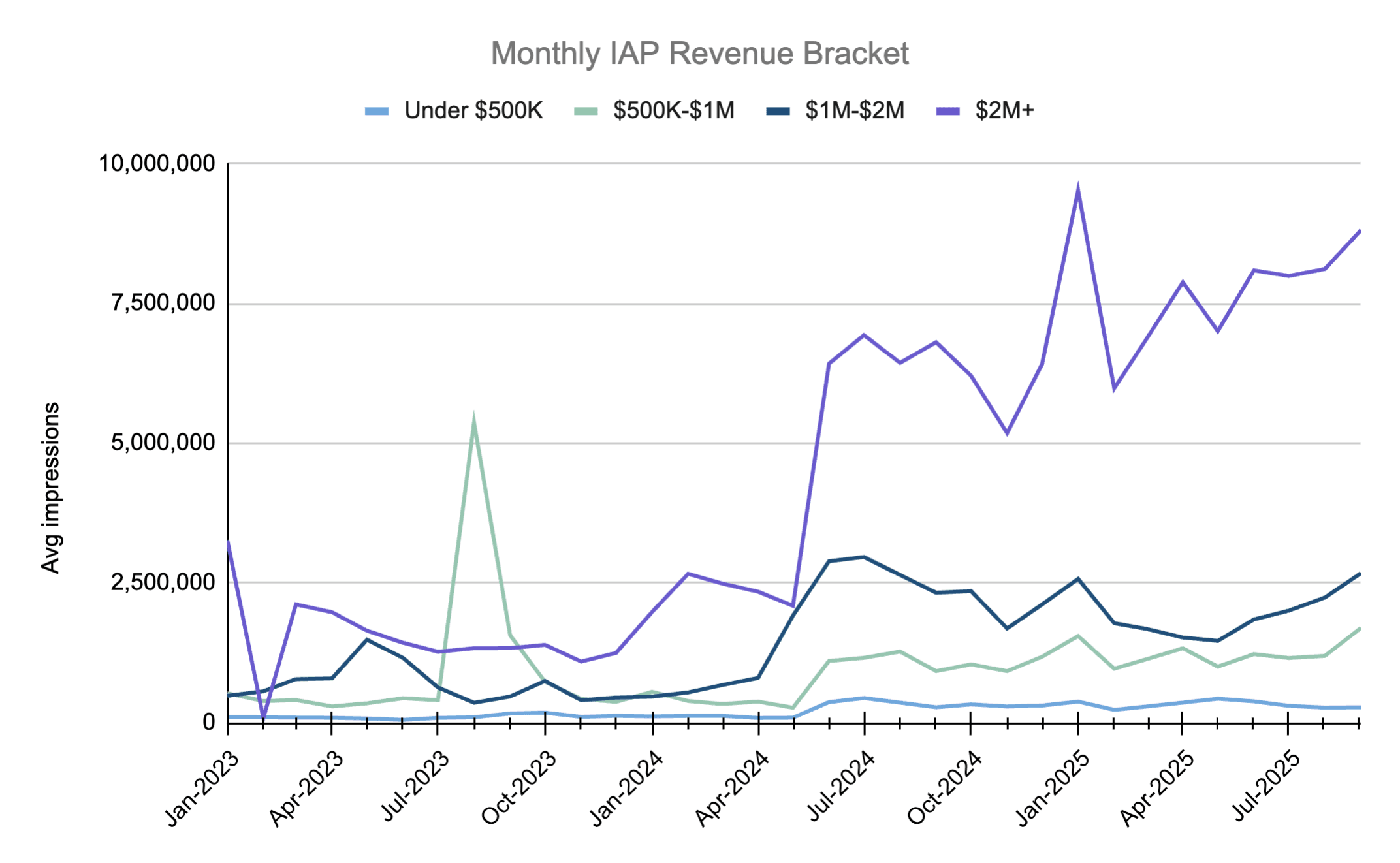
The first clear sign we see in this data is that the number of impressions that are being purchased by studios are generally increasing over time. This affirms the notion that despite CPMs increasing over time, the demand for paid ad impressions continues to grow. Moreover, the increasing trend is true across games in all revenue brackets and categories albeit more pronounced in the larger brackets.
Figure 2: Top 1000 Mid Core Games – Average New Creatives / Month
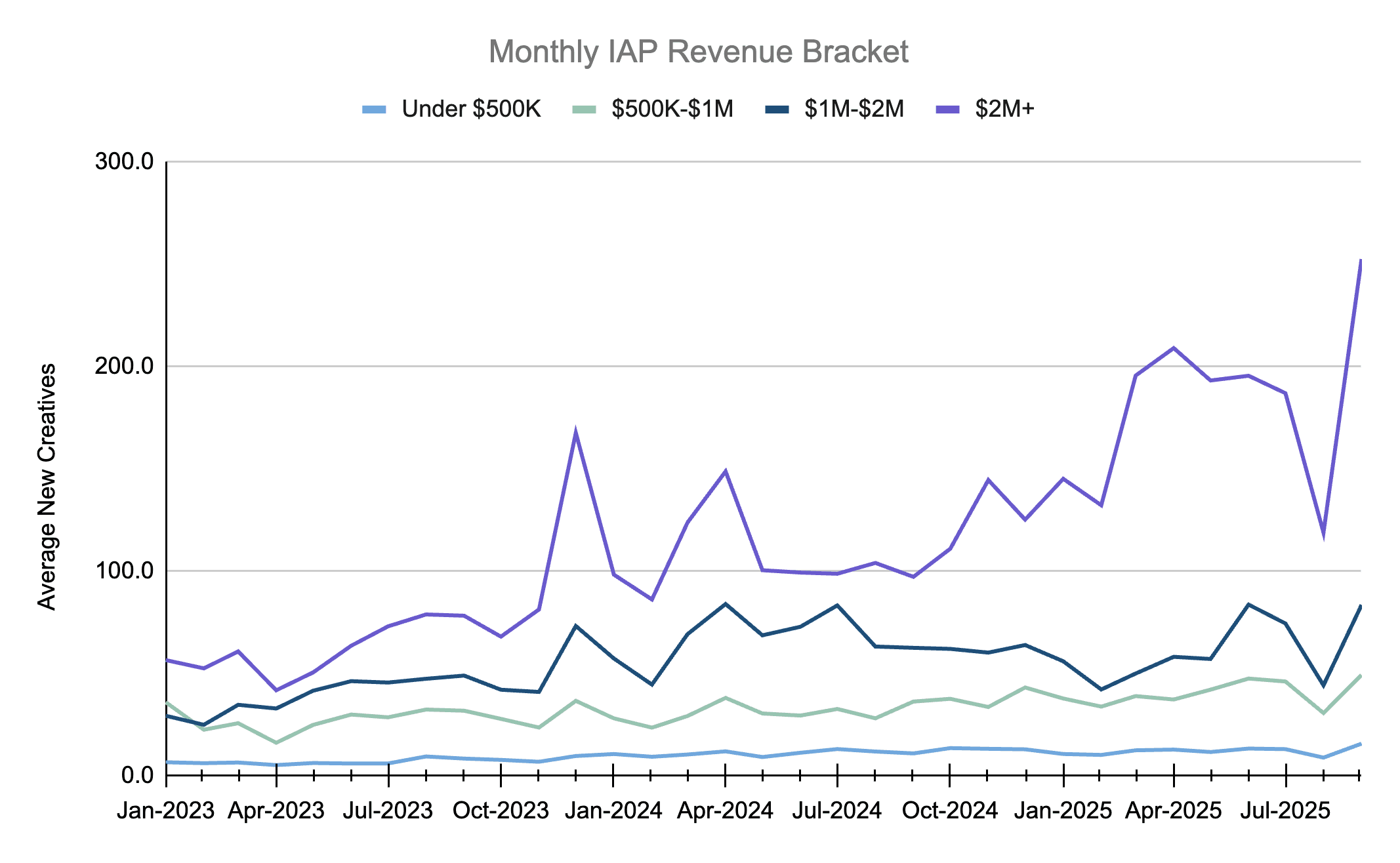
When using the same data set but looking at the number of new creative concepts that are generated each month, we can deduce that the number of creatives being launched is also increasing regardless of the revenue bracket.
This is where the numbers become really staggering. The trend is clear as day here as well, over time we can observe significant growth in the number of new creative concepts being tested on a monthly basis. For the top revenue bracket (>$2M), the September figures suggest that this has reached an average of 252 new concepts tested.
The implication here is that if you are in this top revenue category and are not testing 100+ creative concepts, your competitors are most likely going to find a winning ad faster and more consistently than you over time. A sustained growth trend like this also implies that ad production eventually needs to be machine supported and not dependent on in-house design teams in order to remain competitive.
Figure 3: Top 1000 Mid Core Games – # of Creatives per Million Impressions
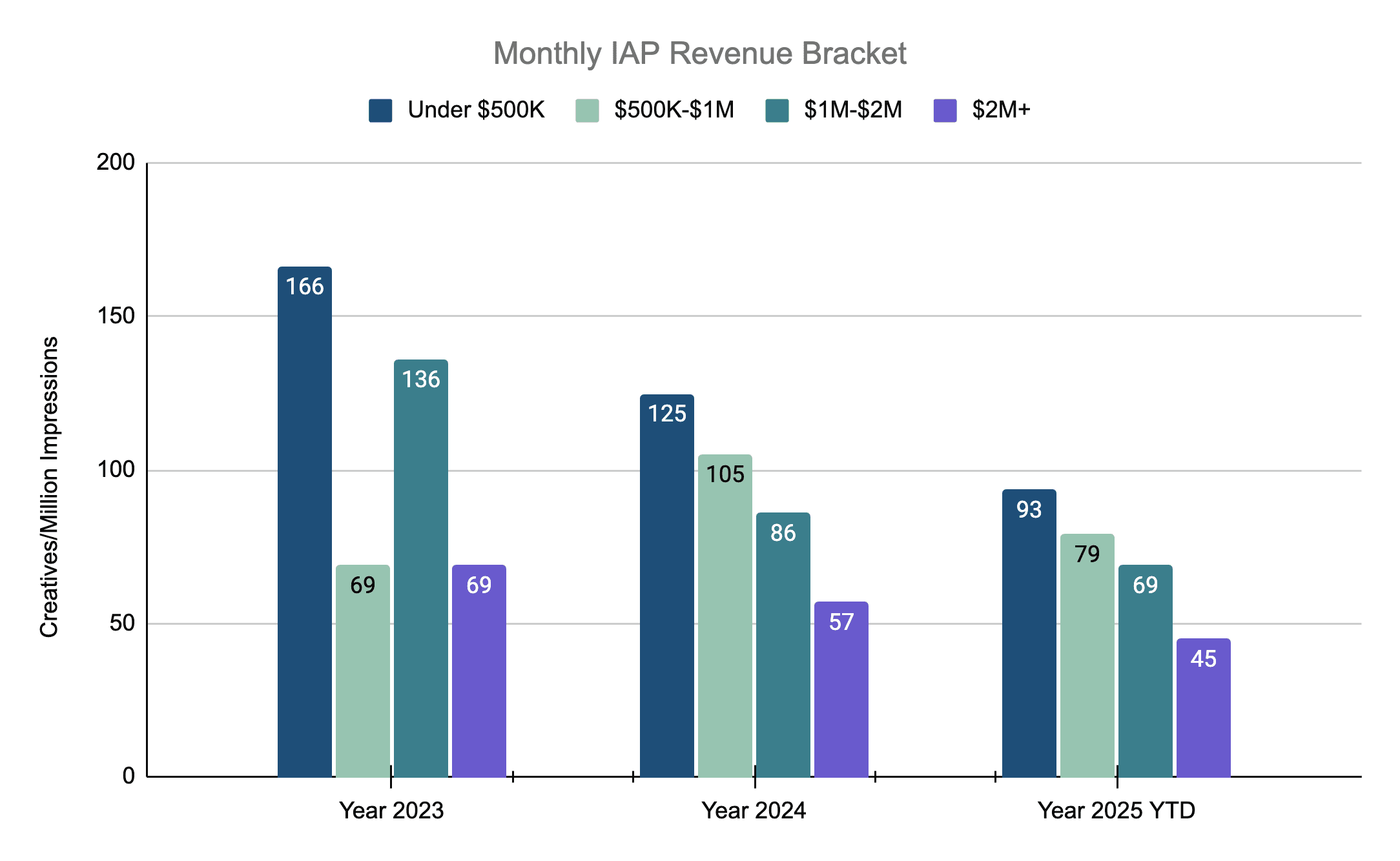
The required number of creatives per million impressions is an interesting proxy to the creative cost for reach. The clear trend that emerges when observing this is that there seem to be economies of scale as you progress into higher IAP revenue brackets and increase creative volume.
As seen in Figure 3, Higher IAP revenue brackets (>$1M) generally require less creatives per million impressions, suggesting that efficiency improves as creative systems mature. In other words, publishers that produce more creatives are generally more efficient in finding winning creatives that can truly scale.
The sharp dip in required creatives for larger studios (>$2M) could also be explained by the fact that they have more resources (e.g. production and UA budget) to test different channels and ad sets. Under-testing may lead to false negatives: teams conclude that a concept “doesn’t scale,” when in reality, they just haven’t tried the concept in enough variations or channels to find a combination that works. As an example, AppQuantum’s Idle Lumber Empire famously tested over 1,850 ad creatives before finally finding a creative that allowed them to spend over $1,000,000 independently.
Ad production is more efficient than ever
AI has dramatically increased the speed and scale of creative production. Tools like Sett and Playablemaker can generate ever-green variations of playable ads based on a set of marketing assets you give to them. With tools like these, studios are able to have a healthy inventory of playable concepts to be fine-tuned and tested – essential for channels like AppLovin, Unity and Mintegral to scale.
Recent advances in diffusion and multi-modal transformers are quickly collapsing the production timeline from weeks to hours. With the release of new generative models such as Sora 2 and Veo 3, studios are now able to produce UGC-style content at a fraction of the traditional cost. These hyper-realistic, influencer-style testimonials have become the strongest acquisition drivers on channels like TikTok and Meta, and AI is making them significantly more scalable.
Campaign optimization is becoming more platform-managed
Performance marketing has long been shifting towards more automation and platform-driven decision making. Each of the largest platforms now offer end-to-end plug and play solutions for digital markers like Meta’s Advantage Plus, Google’s Performance Max and Applovin’s AXON.
These AI driven tools are now essentially able to decide who sees your ads, where and how much you should bid. Once you tell them your business goal, they will dynamically optimize everything on your behalf – shifting budget, improving targeting and testing creatives in real-time. This shifts marketers focus areas to effective instrumentation, creative production and capital allocation between the platforms.
Marketing spends are being funded by UA financing
A rapidly increasing number of studios are funding their user acquisition efforts via user acquisition financing or cohort financing. This financial instrument allows for publishers to fund up to 80% of their monthly marketing spend through non-dilutive growth capital in exchange for a limited revenue share. Once the principal loan is repaid, the revenue share stops and they charge you an interest expense depending on how long the loan was outstanding.
UA financing has essentially provided a war chest for studios who are scaling their marketing spends, enabling them to invest more into funding more creative production as well as media budget to test effectively.
The fastest growing gaming companies have realized that production capacity and testing new creative concepts at scale isn’t just a workflow challenge – it’s ultimately a capital allocation challenge.
To illustrate this, we estimated the annual production and testing budgets based on the average creative output of September 2025. Key assumptions include:
Figure 4: Estimated Annual Creative Budget for Mid Core games
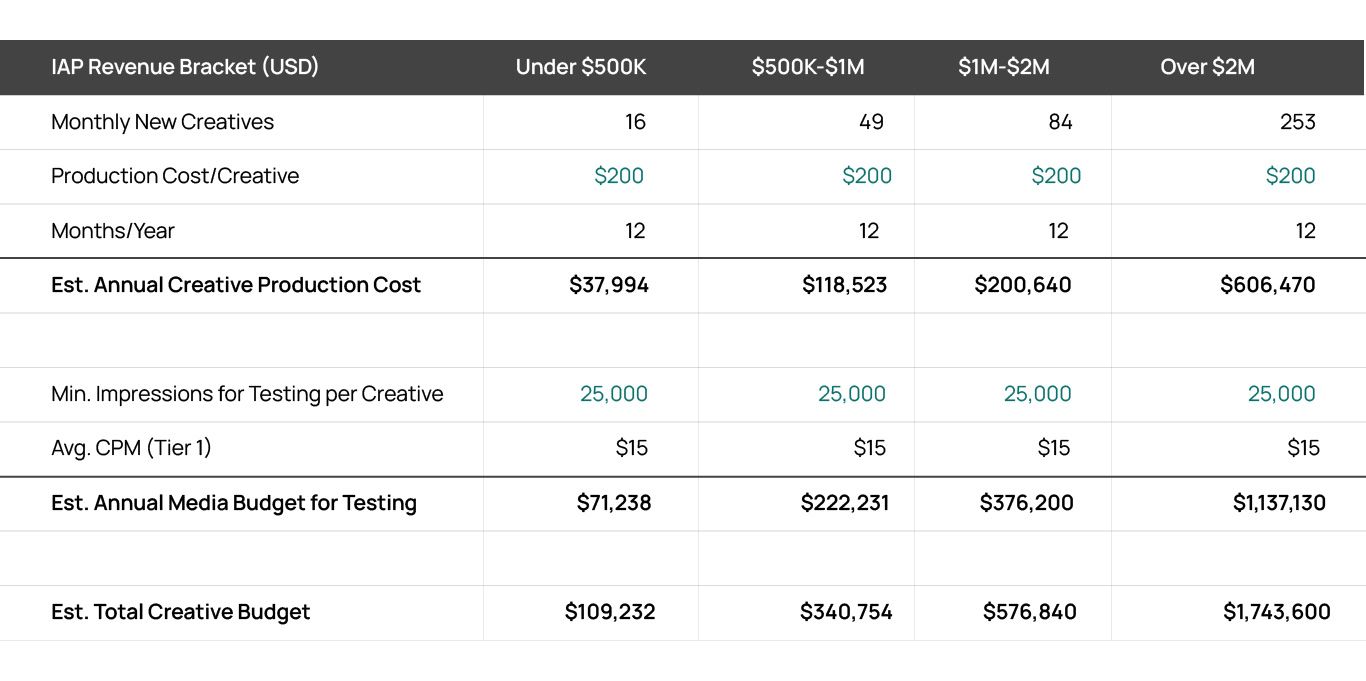
For a midcore game in the $1M–$2M IAP revenue bracket, this level of creative output translates to an average annual production cost of over $200K. This is likely understated for complex assets like playables and 3D creatives.
Beyond production, a media test budget is required to give each concept a fair chance. Based on the 25,000 minimum impressions and a median Tier-1 CPM of $15, the $1M–$2M IAP midcore game needs an additional $375K for media testing alone.
This brings the total annual creative budget for testing to a staggering $575K. This sum represents only the cost to test creatives at the new competitive output level, not the entire annual UA budget, which takes into account scaling creatives that actually work.
Campaign optimization is becoming more automated, AI is unlocking production capacity, and competitors are flooding the market equipped with scalable UA budgets. The bar for creative velocity is skyrocketing and the studios that win are the ones that are keeping pace and constantly investing in experiments.
The arms race isn’t coming – it’s already here. A successful creative strategy is no longer primarily a design problem; it’s an investment problem. Teams that cannot consistently allocate sufficient budgets to experimentation will eventually get out-iterated by those who can. As creative cycles compress and winning concepts burn out faster, the game shifts from “who has the best idea” to “who can afford to test the most ideas.”
Some of the fastest growing businesses in the industry