


Smaller mobile studios need UA financing to keep pace with giants' relentless testing cycles, or risk falling behind.
Dec 25, 2025 - 4 min read
In my second week at PvX, I was asked to sign a document outlining our core values. Integrity, humility, constant learning, ownership - all in all setting a very high bar. One part, in particular, stood out:
“PvX means “Player versus X”. The “X” in PvX is an unknown variable, representing the seemingly infinite challenges facing the game developer. Our mission is to help the Player (the “P” in PvX, the management teams of mobile gaming, and now consumer app businesses) by being the most helpful financing firm in the world.”
That got me thinking about the general perception of the mobile games/apps world as cut-throat and dire: platforms and agencies battling for UA budgets, monetization, creative production and so on. Amidst end-of-the-year celebratory posts on LinkedIn, I’ve noticed quite a few slightly bitter ones, mentioning rising competition, predatory monetization practices, creative arms race with fake ads leading (and winning) with confusion. But how competitive is the mobile gaming market? As we usually do at PvX, let’s dive into the numbers.
Globally, mobile has the largest number of games and the largest number of players, making it by far the most competitive segment of the industry. The ratio however is heavily skewed to Mobile, such that when you divide the number of games by the number of players, mobile ends up with the highest game-to-player ratio, meaning each mobile game is fighting for attention in a vastly more crowded market.
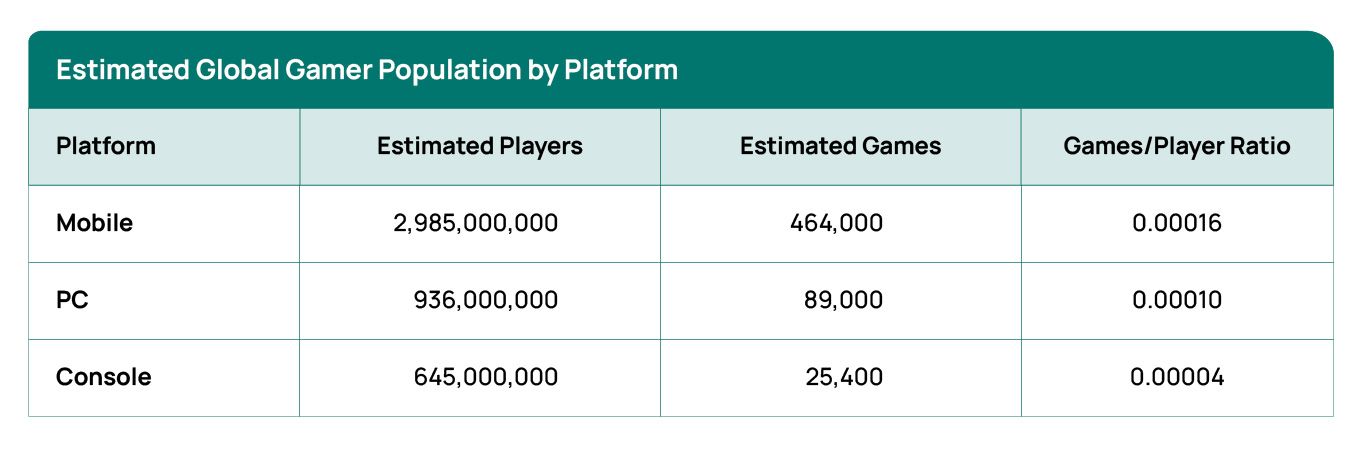
*Data from Newzoo report
In contrast, PC and especially console markets benefit from far smaller libraries, more discovery control through curated storefronts, and higher engagement, especially AAA games, which are marketed months (sometimes years!) before release. This means discoverability is less chaotic and competition is less overwhelming.
Another aspect to consider is that mobile games don’t just compete with other games - but also with consumer apps for the same user’s attention. That means the rapid expansion of the mobile app market will further skew the app-to-user ratio against mobile games.
As a result, mobile is not just the largest market, but also the most saturated, fragmented, and brutally competitive, with every title fighting uphill for visibility and retention.
It is a truth universally acknowledged that a founder in possession of a growing mobile studio must be in want of funding. Over the past 3 to 5 years, the mobile market has settled into a familiar hierarchy: a handful of giants at the top, a layer of well‑capitalised mid‑to‑large publishers beneath them - and then everyone else. But what about everyone else?
In our view mobile gaming is one of the hardest businesses to build. Running even a modestly sized studio is insanely hard, given the constraints mentioned above. Add to the equation the competition with those who don’t count marketing dollars and can afford to test hundreds of creative concepts within a month, and what are you left with?
Throughout my M&A career, I’ve reviewed more than a hundred mobile studios in the due diligence process, focusing on commercial fundamentals and operational strength. The goal was always the same: confirm that the core team could replicate success, identify the areas of growth to invest in, and ensure we (as buyers) could deliver on the promise that 1 + 1 doesn’t just equal 3 - it equals 100.
In terms of investment needs, most founders shared the same ambition: launch more games. Some needed to scale teams with senior talent, others - secure expensive tools and engine licenses, or fund soft launches, or iterative development cycles.
But across every conversation, one theme came up without exception: scaling through UA.
You can build a great game, but you cannot scale it without predictable, sustained user acquisition. In today’s mobile ecosystem, UA is both the engine of growth and its greatest source of friction.
CPI inflation has created a new reality where even smart, efficiently monetised games have to pay to learn. Creative competition, once a differentiator, has turned into an arms race, while algorithmic opacity urges you to get more data to understand what works, and what doesn’t. For a small or mid-sized studio, this creates a structural disadvantage: they are competing against companies who can run learning cycles continuously, absorb losing tests, and reinvest at scale, while you’re budgeting every iteration carefully because your burn rate can’t afford waste.
In other words, the market giants aren’t just bigger; they have the financial resilience to make more mistakes. And in mobile UA, making mistakes fast is the path to eventual efficiency. That’s the paradox founders face daily: every successful UA strategy is built on a long enough runway of unsuccessful ones.
This is the bottleneck - not creativity, not talent, but cash flow.
This is where UA financing becomes transformational rather than tactical.
Instead of treating UA as a cost center that drains liquidity, financing reframes it as growth capital: the fuel a studio needs to compete fairly in a market dominated by giants.
UA financing unlocks something powerful: it removes learning velocity from your bank account balance. With financing, smaller studios can:
Most importantly, UA financing restores the competitive equilibrium. It means that the studios with the best product thinking, the best creative instincts, the best operational discipline, and not just the biggest budgets, can win. When cash flow stops being the ceiling, the game finally becomes about merit again.
Imagine a world where the ability to grow doesn’t depend on the balance sheet, but on the strength of creative ideas.
Where you don’t have to choose between building and scaling: testing ideas without the fear of jeopardising the payroll, experimenting with new genres, soft-launching in multiple markets, and refining gameplay loops until they resonate - all because the financial runway supports the creative one.
This is the promise of UA financing at its best: capital becomes a catalyst, not a constraint. It gives founders room to think long-term, and teams the confidence to test, fail, and refine without the existential pressure many operate under today. It narrows the gap between incumbents and emerging studios by giving both access to the same weapon: learning velocity.
When more studios compete on equal footing, the entire industry benefits: better games, more innovation, more diverse ideas - and a landscape where the next breakout hit can come just as easily from a 10-person team as from a 500-person publisher.
At PvX, this isn’t just financing.
It’s our mission statement: reducing the variables stacked against the “Player” and giving founders confidence, clarity, and capital to any “X”.
Needless to say, I signed the values document without any hesitation.
Some of the fastest growing businesses in the industry